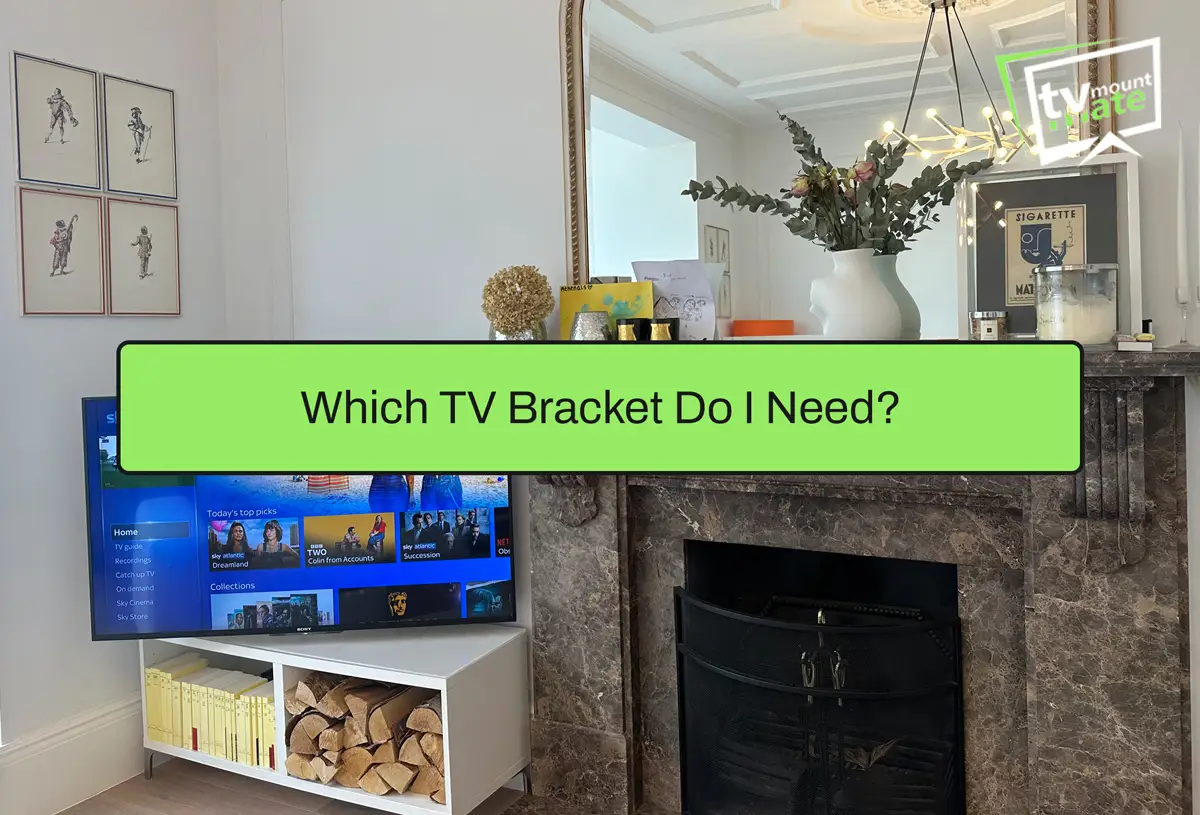
For most customers whose sofa faces the television and who do not need to move the screen, a fixed bracket is the sensible starting point. A tilting bracket is useful when the television sits higher and the viewing position benefits from a downward tilt. A full-motion bracket is for a genuine movement requirement, such as viewing from two parts of a room, mounting in a corner or pulling the screen into a better angle.
Whichever type is chosen, it must match the exact television and the complete wall arrangement, not just the advertised screen size.
Every installation is different. TV size and weight, the exact television model, wall construction, the main viewing position, whether real movement is needed, the required height, socket and cable position, usable fixing positions and the wall plate’s own design all play a part in the final decision.
Quick TV Bracket Comparison
| Bracket type | Choose it when | Main limitation | Check before buying |
|---|---|---|---|
| Fixed | The TV faces one main seat and doesn't need to move. | Rear cables, ports and locking mechanisms can be harder to reach. | Wall-plate width against usable fixing positions, plug and socket clearance. |
| Tilting | The TV sits above eye level and would benefit from angling down. | Doesn't fix every reflection, and tilt range varies by product. | Tilt angle range and whether the mechanism holds its position. |
| Full-motion | You genuinely need to view from more than one position, or the TV is going in a corner. | Adds leverage at the wall plate, especially when fully extended. | Arm length, wall-plate design and cable length across the full range of movement. |
| Flush or model-specific | An ultra-close finish matters and a matching bracket exists for your exact TV. | Very little rear clearance for cables, plugs and ports. | Socket and plug clearance, and whether the supplied fixings suit your wall. |
Full-motion isn’t a step up from fixed. It solves a different problem, and if that problem doesn’t exist in your room, the extra movement adds cost and leverage without adding anything you’ll actually use.
The Three-Fit Bracket Check
I check three things separately before recommending a bracket: how the television will actually be used, whether the bracket fits the exact television, and whether the bracket and wall plate suit the wall construction and the position that’s wanted. A bracket can fit the television and still be wrong for the installation.
1. How will the television be used?
I ask where the main viewing position is, whether the television will be watched from another seating or dining area, and whether the customer will genuinely move it or just likes the idea of being able to. How often it would actually be moved matters, along with whether it’s going in a corner, what height is required, and whether a close finish to the wall is more important than movement.
Most customers whose television faces one main seat and doesn’t need to move can start with a fixed bracket.
2. Does it fit the exact television?
A bracket must not be chosen from screen size alone. Where it applies, I check the exact television model, its VESA mounting pattern, the television’s weight without its stand, the bracket manufacturer’s stated weight capacity, the mounting-hole arrangement, any model-specific requirements, and whether the mounting screws and spacers supplied actually suit that TV. I confirm the bracket’s stated capacity against the television’s verified weight where that information is available, whatever type of bracket it is.
“Universal” means the bracket supports a stated range of VESA patterns, screen sizes and weights. It does not guarantee compatibility with every television. Screen size is only one part of compatibility, so check whether the wall mount fits your exact television before buying.
3. Does it fit the wall and required position?
This covers the wall construction, whether there’s timber or metal framework behind it, the condition of the plasterboard, the usable fixing positions, the wall plate’s width and hole arrangement, whether the TV can finish centred, socket and plug clearance, the cable route, movement clearance and the extra leverage created by an extending arm.
A bracket can fit the television but still be wrong for the installation because the wall plate may not reach the usable fixing positions, the television may not finish centred, or the socket, plug and cables may prevent the bracket from sitting where it needs to. If the proposed wall is plasterboard, the bracket choice must be considered alongside the framework, board and fixing arrangement.
Fixed TV Brackets
A fixed bracket is usually my first choice when the television faces one viewing position and there is no practical reason for it to move. I also commonly prefer a fixed bracket for a large television when movement is unnecessary, but the final decision still depends on the TV, wall and required position.
A standard fixed bracket doesn’t automatically give an ultra-slim finish. A genuinely close finish may need an ultra-slim or model-specific bracket instead. Fixed brackets can also make rear cables, ports and locking mechanisms harder to reach once the TV is up. A fixed bracket can still be used above eye level if the customer is comfortable with that position, and it isn’t automatically the right answer on every plasterboard wall either.
I’ve rejected an ultra-slim arrangement before where the existing socket and plug behind the television didn’t leave enough room for the power connection. The issue wasn’t just the gap between the television and the wall. It was the absence of suitable clearance for the plug and cable.
Tilting TV Brackets
I recommend a tilting bracket when the television needs to sit higher and the viewing position benefits from the screen being angled down. Bedrooms and televisions above fireplaces are common examples, but tilt isn’t compulsory in every higher installation. The required TV mounting height can also determine whether a fixed or tilting bracket is the better option. A television above a fireplace requires a separate assessment of height, viewing angle, wall construction and the fireplace arrangement.
The decision depends on the viewing position, reflections and customer preference. Tilting may help with some reflections but doesn’t guarantee glare will disappear, since windows and room lighting can still cause it regardless of angle. Tilt ranges vary by product, and a tilting bracket often gives more rear access than an ultra-slim fixed mount. Some inexpensive tilting mechanisms don’t hold their selected position particularly well, which is worth checking before you buy rather than after.
Full-Motion TV Brackets
Full-motion is genuinely useful in an open-plan room with different viewing areas, watching from a sofa and a dining area, a commercial setting where the screen needs to swivel, a corner position, a narrow or awkward wall space, pulling the television into a better viewing angle, or moving it close to the wall when it isn’t being watched.
A full-motion bracket is not better than a fixed bracket. It performs a different job. It’s worth using when its movement solves a real room-layout or viewing problem. If the customer will never extend or turn the television, adding an arm doesn’t automatically improve the installation.
Most full-motion mounts also offer some tilt, though the available movement varies by model, and they come as single-arm or double-arm designs. Arm length matters because it changes the leverage created once the bracket is extended, and that leverage has to be matched against the wall-plate design, the television’s size and weight, and the suitable fixing positions available. Cable length and movement need thinking through too, since cables can become visible, trapped or pulled if they weren’t planned for the bracket’s full range. Clearance matters when the bracket folds back, and the television won’t necessarily finish directly over the centre of the wall plate. Wall plates sometimes need to go in off-centre so the screen finishes where it should.
I get particularly cautious with inexpensive single-arm mounts as the television gets larger, since that’s usually where the wall and fixing arrangement need the closest look, not because there’s a fixed size where full-motion stops being appropriate.
I do not reject a full-motion bracket simply because the visible surface is plasterboard. I assess the framework behind it, the condition of the board, the usable fixing positions, the television, the wall plate and the arm’s extension. If I can’t establish a suitable fixing arrangement for the additional leverage, I recommend a fixed bracket or change the proposed installation.
Flush and Model-Specific Brackets
Samsung Frame Slim Fit mounts, original LG G Series flush brackets, Hisense Canvas mounts and other manufacturer-specific brackets are designed to sit as close to the wall as possible for one particular television.
A flush bracket can give an excellent finish, but only when the socket, plug, cables and wall have been planned for the limited space behind the television. A bracket designed for a particular TV can still arrive with wall fixings that aren’t suitable for the wall in front of me. Fixings supplied with a television or bracket are not automatically suitable for every wall construction.
I’ve sometimes changed from an intended flush mount to a standard fixed bracket because the existing socket or plug needed more clearance than the flush arrangement allowed.
Specialist Bracket Types
Long-arm full-motion brackets, corner mounts, pull-down fireplace mounts, motorised mounts and ceiling mounts all exist for a specific purpose rather than because they’re automatically better than a standard bracket. I’ve installed all of these, but I don’t recommend them blindly. The room, wall, television, required movement and the customer’s actual needs still have to be assessed first.
Brand Experience
I’ve regularly installed brackets from Sanus, Vogel’s, One For All, VonHaus, Sandstrøm and TV Mount Mate’s own supplied ranges. In my experience, Sanus produces strong low-profile options and Vogel’s makes high-quality full-motion products, but that isn’t a universal recommendation. There’s no single best brand, and suitability is decided for the installation in front of me, not by the logo on the box.
Why Full-Motion Was Right for This Camden Room
On 20 March 2026, I mounted a 55-inch Sony BRAVIA 8 in Camden, NW6, on solid brick, using the customer’s own Vogel’s single-arm full-motion bracket. The television needed to sit in a restricted section of wall between an outer wall and a fireplace.
The customer wanted two genuinely different things: the TV close to the wall when it wasn’t being watched, and pulled forward and angled into the room for viewing. A fixed bracket could have kept the television close to the wall, but it would not have allowed the customer to pull it forward and angle it towards the room for viewing. The wall plate had to go in off-centre for the screen to finish in the right place once extended, and the cables were planned around the bracket’s full range of movement rather than just its resting position.
After installation, the television moved cleanly through both its stored and viewing positions.

In this room, full-motion was the right choice because the customer needed two genuinely different positions. The screen could sit close to the wall when it wasn’t being watched, then extend and turn towards the room for viewing. The bracket solved a real layout problem rather than adding movement that would never be used.
When Fixed Was the Better Decision
On 17 August 2026, a customer in Bromley, BR2 contacted me through WhatsApp about a 65-inch Samsung S90F. A full-motion bracket fitted by a handyman was pulling away from a hollow plasterboard wall, and photographs showed the bracket coming loose along with plastic wall plugs at the fixing points.
On inspection, I removed the television and the original bracket, filled the old holes, and fitted a One For All fixed bracket in a revised fixing position, keeping the television in the visual position the customer wanted. The customer assisted with the lift, and the result was secure. A bracket that looks suitable from its advertised screen-size range doesn’t prove the wall plate, wall construction and fixings actually form a suitable installation together.
Common Bracket-Buying Mistakes
The most common bracket mistake I see is choosing from the advertised TV size without considering the wall and final position. Buying full-motion when there’s no real need to move the screen is another regular one, along with choosing an inexpensive single-arm bracket for a large television without checking whether the wall and fixings can take the leverage.
On the wall side, the most frequent problems are a wall plate too narrow to reach usable fixing positions, a bracket ending up over an existing socket, or not enough plug clearance behind the TV. Bracket arms installed in the wrong position, a television finishing at the wrong height, or a full-motion bracket that can’t fold back with the screen centred all trace back to the same thing: not checking the wall and the exact television model before fitting anything.
Customers also regularly assume the wall plugs supplied in the box must be suitable for their wall. They are not automatically suitable. It’s also worth checking parts are all present, especially after a house move, since a bracket missing a fixing arm or plate is a common and avoidable delay.
What to Send Before Buying a Bracket
Before buying, it helps to send: the television size, the exact model if you have it, the wall type if known, a clear photograph of the proposed wall, a photograph or link for the bracket you’re considering, whether the television needs to move, the viewing positions you actually want, and any socket, cable or furniture restrictions.
You can buy your own bracket, but checking with me first can prevent a bracket change once I’m on site.
Frequently Asked Questions
Run it through three checks: how the television will actually be used, whether the bracket fits your exact television, and whether the bracket and wall plate suit the complete wall arrangement.
Fixed when the TV faces one main position at an agreed height. Tilting when a higher position benefits from downward adjustment. Tilt isn't automatically required in every higher installation.
Only when the viewing position or installation height benefits from it. An unused feature isn't an upgrade.
Most provide some tilt alongside extension and swivel, but the available movement varies by model. Check the manufacturer's specifications.
A tilting bracket mainly angles the screen vertically. A full-motion mount can extend and swivel as well, and often provides some tilt too.
No. It's useful for a different purpose. If movement isn't required, a fixed bracket is often the more appropriate choice.
No. Check the exact television's VESA pattern, weight, mounting requirements and the bracket manufacturer's specifications.
It means the bracket supports a stated range of televisions, VESA patterns and weights. It does not mean every television.
There is no universal best bracket. I've had good first-hand experience with Sanus low-profile products and Vogel's full-motion mounts, but the right choice depends on the television, wall, room and required movement.
Get Advice Before You Buy
Send me your television size and model, the wall type if you know it, a photograph of the wall, details of any bracket you’ve already bought, and the viewing or movement positions you actually need. I can tell you whether a bracket you’ve already chosen is suitable, or supply the right one as part of the installation.
TV bracket supply and installation is available as part of any booking.
Request a fixed quote
To request a quote, send TV Mount Mate:
Your postcode
TV size and exact model
Parking restrictions
Wall type, if known
Bracket information
Any additional services required
Relevant photographs
TV Mount Mate will review the information, provide a fixed quote and offer an available one-hour appointment window.
About the Author
Written by: TV Mount Mate
This guide is based on TV Mount Mate’s own experience: more than 10 years of hands-on TV wall mounting and over 6,000 installations.