

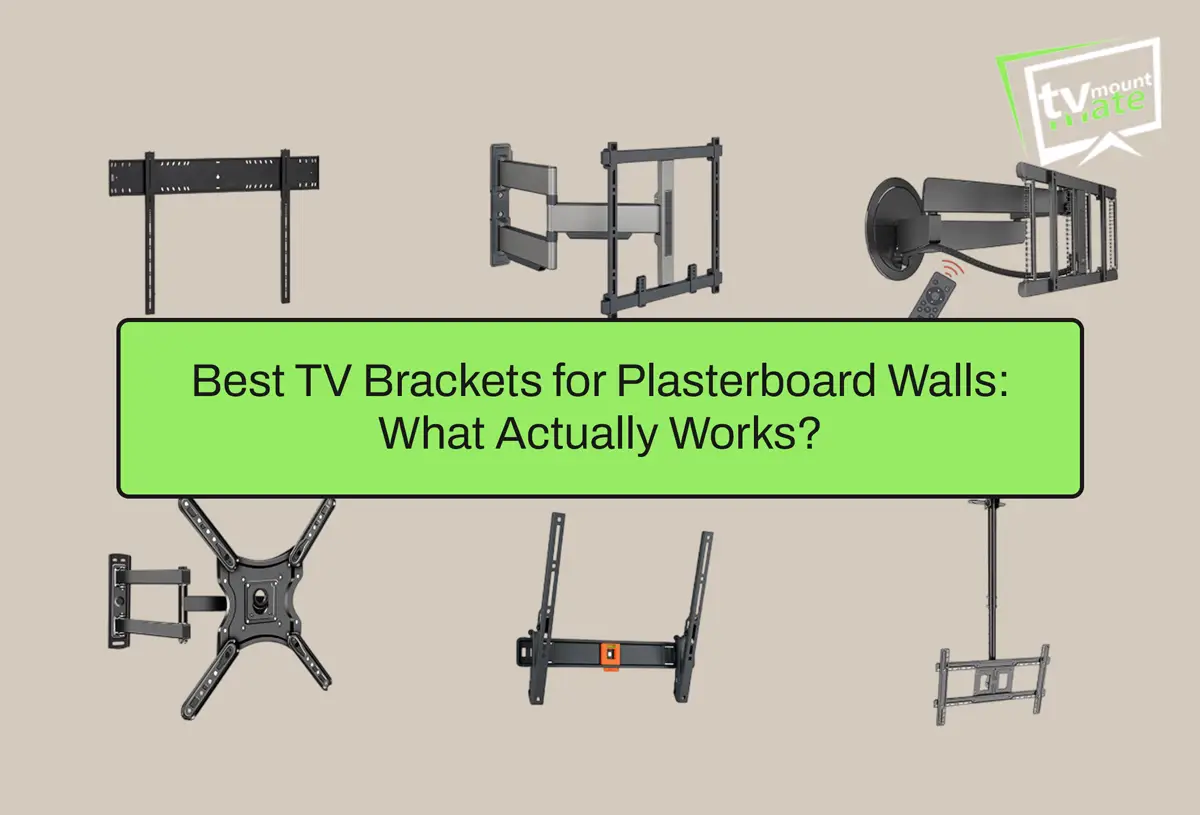
There is no single “best” bracket for every plasterboard wall. For most televisions over 50 inches, we usually recommend a fixed or tilting bracket because it keeps the television close to the wall and creates less leverage than a full-motion bracket.
But the right bracket for your home depends on the television’s actual weight, how the wall is built, where the studs sit, and where your sockets and cables are.
This guide explains how TV Mount Mate makes that decision, based on real installations rather than a generic checklist.
In this guide
What makes a TV bracket suitable for plasterboard?
Fixed, tilt or full-motion: which suits plasterboard?
Why the wall plate matters
VESA compatibility versus wall fixing positions
What happens when the studs do not align with the bracket?
What fixings can be used on plasterboard?
Can plasterboard hold a 65-inch or larger TV?
Four lessons from real TV Mount Mate installations
What makes a TV bracket suitable for plasterboard?
Yes, in many cases you can fix a TV bracket to a plasterboard wall. Many plasterboard walls can support a television when the bracket, fixings and wall construction are properly assessed and matched to each other.
Whether the wall alone is “strong” or “weak” is not really the right question. What matters is the whole combination:
The actual weight of the television
How the wall is built: timber stud, metal stud, dot-and-dab or a single hollow layer
The condition of the board itself
How deep the cavity is behind it
Where the timber or metal studs run
The design of the bracket’s wall plate
Where the fixing holes fall on that plate
The build quality of the bracket
Where your sockets and cables sit
The viewing angle you want
How often the television will be moved once it is mounted
We check all of this before recommending a bracket for a plasterboard wall. A bracket that works well in one room can be the wrong choice in the next, simply because the wall behind it is built differently.
Fixed, tilt or full-motion: which suits plasterboard?
The three main bracket types behave differently once they are carrying a real television, and that difference matters more on plasterboard than it does on brick or block.
Fixed brackets hold the television flat and close to the wall, with no movement once fitted. Because the television does not extend outwards, it creates less leverage than a full-motion bracket.
Along with tilting brackets, this is why we usually recommend a fixed or tilting bracket for televisions over 50 inches on plasterboard. The final choice still depends on the wall and that specific bracket’s wall-plate layout.
Tilting brackets work in a similar way, staying close to the wall while adding a downward tilt to reduce glare or improve the viewing angle from a higher position.
Tilting brackets do not automatically have a wider wall plate than fixed brackets. Plate width varies by model, so the actual plate needs to be checked, not just the bracket category.
Full-motion brackets extend away from the wall and swivel. The further the arm extends, the more leverage is placed on the wall plate and its fixings.
On plasterboard, we look at the whole installation before fitting one:
The television’s size and actual weight
Whether it will be extended and moved regularly
The bracket’s build quality
Whether it uses a single-arm design
The condition of the wall and plasterboard
The likely stud positions
The width of the wall plate
The number of suitable fixing positions available
The length of the extending arm
If several of these factors are working against the proposed installation, we will explain the problem and may suggest a different bracket or fixing approach.
That does not mean every full-motion bracket is unsuitable for every plasterboard wall. It means the complete wall, television and bracket combination must be assessed together.
| Bracket type | How it behaves once fitted | What we check on plasterboard |
|---|---|---|
| Fixed | Sits flat and close to the wall, with no movement. | Plate hole positions, TV weight and exact placement before drilling. |
| Tilt | Stays close to the wall but tilts downwards. | The same points as a fixed bracket, plus space for the tilt mechanism. |
| Full-motion | Extends and swivels away from the wall. | Plate width, usable fixing points, stud positions, bracket quality and arm length. |
Why the wall plate matters
The wall plate is the part of the bracket that meets the wall, and it is often the deciding factor on plasterboard.
When we assess a bracket, we look at:
How wide the plate is
How many fixing holes it has and where they fall
Whether any of those holes line up with a usable stud
Whether the television can be centred where you want it
How much space is left around sockets
Whether cables can still be routed or concealed
Where the VESA mounting points sit on the back of the television
How high the television will finish once mounted
The overall build quality of the plate and bracket
Whether the bracket remains level once the television is fitted
Two brackets with the same price and listed maximum weight can behave differently on the same plasterboard wall because of how their wall plates are designed.
VESA compatibility versus wall fixing positions
These are two separate checks, and mixing them up is a common mistake.
VESA is the hole pattern on the back of your television that the bracket arms attach to. It tells you whether the bracket fits your television.
It does not tell you whether the bracket’s wall plate will align with a stud, cavity or suitable fixing position on your wall.
A bracket can be an exact VESA match for your television and still be the wrong choice for your wall if its wall-plate holes do not fall anywhere useful.
We check compatibility with the television and compatibility with the wall separately because they are not the same question.
Our guide on TV and bracket compatibility explains VESA matching in more detail.
What happens when the studs do not align with the bracket?
This happens regularly, and it does not automatically mean the wall cannot take a television.
When usable stud positions do not match the bracket’s fixing holes, we explain the problem to the customer and consider the realistic options:
A different bracket with a wall-plate layout that better suits the available studs
Specialist cavity fixings suited to the board and cavity
Metal toggle fixings where the cavity and wall allow them
GripIt fixings where they are suitable for the wall
Fixing directly into a usable stud where alignment allows it
Repositioning the television slightly where acceptable
Additional support where the wall or bracket requires it
There is no single method that works on every plasterboard wall. The suitable option depends on the board, cavity, stud positions, television and chosen bracket.
What fixings can be used on plasterboard?
There is no single strongest fixing for every plasterboard wall. The fixing method depends on what is behind the board.
Timber studs: Suitable screws can be fixed directly into sound timber studs.
Metal studs: The fixing method must be chosen for the particular metal-stud construction, wall condition, bracket and proposed load. Metal studs do not all have the same gauge, condition or spacing.
Hollow plasterboard with no usable stud: Metal toggles, GripIt fixings or another suitable cavity fixing may be considered after checking the plasterboard and cavity behind it.
Dot-and-dab plasterboard: The approach depends on the depth of the gap and the solid material behind the plasterboard. Dot-and-dab walls vary, so the construction must be checked rather than assumed.
We have not listed load ratings because a manufacturer’s rating for one fixing does not automatically apply to a particular wall, television and bracket combination.
If you want fixing specifications, check the current manufacturer information for the exact product and treat it as one part of the complete assessment.
Can plasterboard hold a 65-inch or larger TV?
Screen size alone does not tell you whether a wall is suitable, and there is no single maximum weight that applies to every plasterboard wall.
For 65-inch, 75-inch and larger televisions, the important details include:
The television’s actual weight
The weight of the bracket
Whether the bracket is fixed, tilting or full-motion
The arm length and leverage it creates
The wall-plate design
The number and position of usable fixing points
The condition of the plasterboard
The location of the studs
How the wall is constructed
The depth of the cavity
Whether the television can be handled and lifted correctly during installation
A correctly matched fixed bracket on a properly assessed wall may be suitable for a large television. A poorly matched bracket and fixing arrangement can create problems with a much smaller television.
That is why we assess the complete installation rather than making a decision using screen size alone.
Brackets We Have Used on Real Plasterboard Installations
| Installation | Bracket | Why it suited the job |
|---|---|---|
| East Dulwich, 65" LG C5 | One For All fixed bracket | Suitable wall-plate layout for the assessed cavity and fixing positions. |
| Gidea Park, 77" LG G5 | Original LG flush bracket | Preserved the intended flush finish while working with available fixing positions. |
| Greenwich, 55" Hisense S7 Canvas | Original no-gap bracket | Existing wall-plate positions aligned with usable metal studs. |
Four lessons from real TV Mount Mate installations
East Dulwich, SE22
A 65-inch LG C5 OLED needed to be mounted on a single-layer hollow plasterboard wall with no usable stud aligned with the required position. Currys had previously declined the installation.
We fitted a One For All fixed bracket using six metal toggle fixing points. The television was centred between the wall lights, and we worked around the existing power socket behind it. There were no HDMI, aerial, Ethernet or optical cables to conceal.
The lesson was that without usable stud alignment, the wall, cavity, bracket and fixing layout all needed to be assessed together.
See the East Dulwich installation.
Gidea Park, RM2
A 77-inch LG G5 OLED needed to be fitted using its original LG flush bracket on a plasterboard wall with metal studs.

Only one usable bracket position aligned with a stud, so we combined that stud fixing with six metal toggles. Power was recessed so the television could sit flush, while the HDMI and Ethernet cables were concealed.
The lesson was that the bracket layout, stud position, recessed power and cable route all had to work together.
See the Gidea Park installation.
Greenwich, SE10
A 55-inch Hisense S7 Canvas came with its own no-gap, art-style bracket. The customer wanted to preserve the close, picture-style finish.
The plasterboard wall had metal studs that aligned with usable positions on the bracket’s wall plate. We mounted the television using the supplied bracket and concealed the cables.
The lesson was that when a television’s original bracket suits both the wall construction and the finish the customer wants, it will often be the appropriate bracket to use.
See our TV wall mounting work in Greenwich.
Southgate, N14 repair
We were called to an 85-inch Samsung QLED on a plasterboard wall. The exact construction behind the plasterboard was not recorded.
The television had started to move. A handyman had used the plastic plugs supplied in the bracket box, and some of the drilled holes were larger than the plugs, leaving the fixing points loose.
We removed the television and bracket, remeasured the position, drilled new fixing holes and remounted the television using metal toggles suitable for the assessed installation.
The lesson was that plastic plugs supplied with a bracket should not automatically be used on plasterboard. The wall construction, hole size, bracket and fixing arrangement must all be considered together.
Learn more: Why TVs Pull Out of Plasterboard Walls
When to ask an installer to check the wall
It is worth asking an installer to check the wall if:
You are not confident about what is behind it
Sockets or cables are close to the proposed fixing area
The television is particularly large
You are considering a full-motion bracket
The plasterboard is damaged
The available stud positions are uncertain
Before drilling, we check the likely wall construction, whether the studs are timber or metal, where cables and pipes may run, the condition of the wall and the proposed fixing positions.
We use a Bosch detector to help identify what may be behind the wall. A strong magnet can also help locate metal studs or fixings.
No detector guarantees that a wall is completely clear. It helps identify likely routes and structural positions, which is why it is used as one part of the assessment.
What to check before buying a bracket
Your television’s actual weight and VESA hole pattern
How your wall is built, or whether you need an installer to confirm this
The bracket’s wall-plate width and fixing-hole positions
Whether there is enough space around sockets and cables
Whether you want a fixed, tilting or fully adjustable finish
The build quality of the bracket, not just its listed maximum weight
If you would rather have the bracket recommended and supplied as part of your installation, our bracket supply and installation service explains the available options.
Conclusion
The best TV bracket for a plasterboard wall is not a single product. It is the fixed, tilt or full-motion bracket that suits the television’s weight, wall construction, available fixing positions, sockets and cable routes.
Getting that combination right is what determines whether the proposed installation is suitable.
If you need help choosing a bracket, see how TV Mount Mate approaches professional TV mounting on plasterboard walls or send your TV size, wall details and postcode for a fixed quote.
Need help choosing the right TV bracket?
Send TV Mount Mate your postcode, TV size, a photograph of the wall and details of any bracket you already have.
We will check the proposed setup, explain the suitable bracket options and provide a fixed quote before you book.
No deposit required. Payment on completion.
About the Author
Written by: TV Mount Mate
This guide is based on more than 10 years of hands-on TV mounting experience and over 6,000 completed installations across London, Essex and Kent.
TV Mount Mate’s lead installer holds a Level 2 certificate and is Enhanced DBS checked. TV Mount Mate is fully insured up to £2 million.