

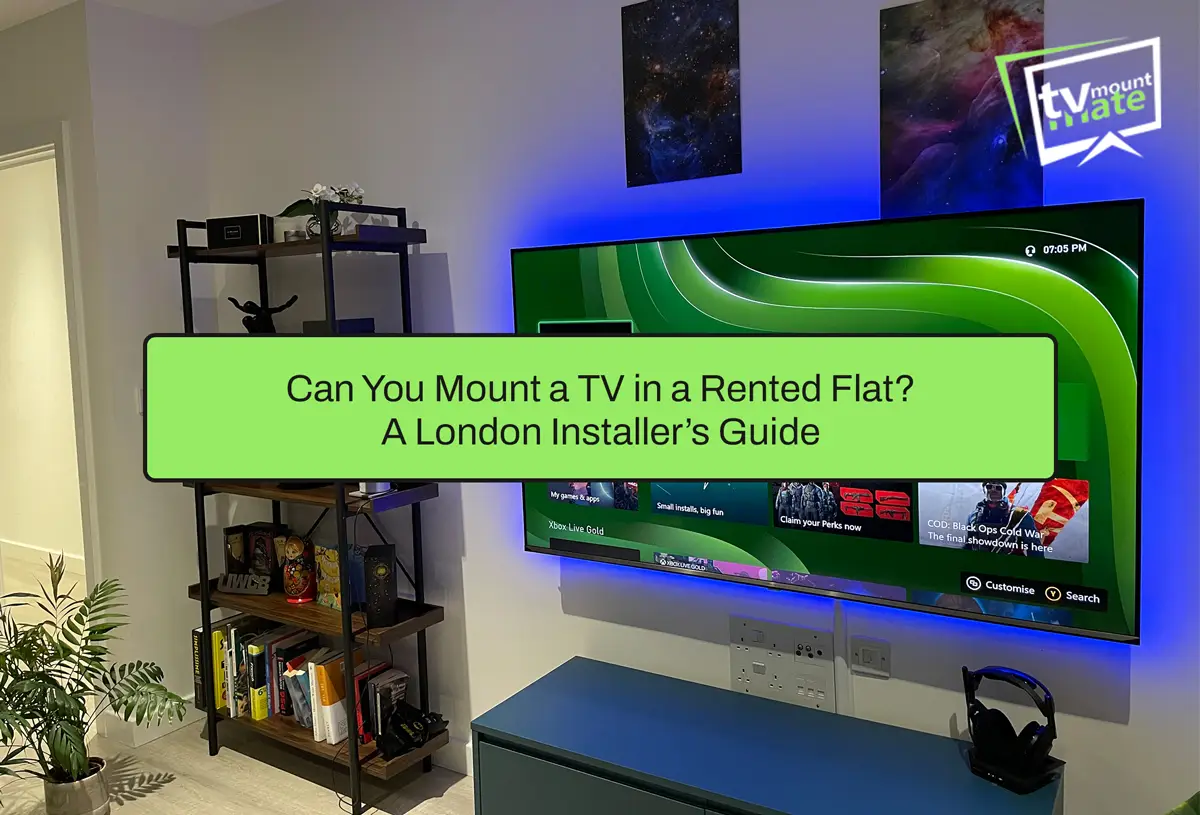
Yes, a TV can often be mounted in a rented flat, but check the tenancy agreement first and discuss the proposed work with the landlord or letting agent before booking anything. Mounting leaves fixing holes, and the cable method can create additional work when it is time to make the wall good again. The wall, bracket and cable route should therefore be considered before drilling starts.
TV Mount Mate relies on the renter to confirm that any required permission has been obtained. We do not contact the landlord or letting agent on a customer’s behalf, inspect the tenancy agreement or provide legal advice. Complying with the tenancy agreement remains the tenant’s responsibility. There is no guarantee that every landlord will agree to a wall-mounted TV or that an installation will have no effect on a deposit.
Before You Book
Check the tenancy agreement
Obtain any required permission, ideally in writing
Identify the wall type if possible
Decide whether the TV genuinely needs to move
Agree the cable finish before booking
Consider what will happen when the bracket is removed
Do You Need Landlord Permission to Mount a TV?
Tenancy agreements can contain conditions about alterations, drilling or returning the property to its original condition. Because the wording varies, read your agreement and ask your landlord or letting agent if you are unsure. If permission is required, obtain it before booking and keep the written response.
We have delayed an installation while a tenant checked permission, and the landlord subsequently declined the work. This is why we advise renters to confirm permission before booking. TV Mount Mate relies on the customer’s confirmation and does not contact the landlord, inspect the tenancy agreement or verify permission independently.
How Much Damage Does Mounting a TV Actually Do?
A properly installed and carefully removed fixed bracket normally leaves fixing holes and wall plugs or anchors that need to be removed or dealt with. We have also seen paint marks and an outline where the wall plate previously sat against the wall.
Enlarged or torn holes are not the intended result of a correct installation. That kind of damage can result from poor installation or careless removal.
There is no single number of holes or one universal hole size that applies to every installation. It depends on the bracket, wall construction, fixing method and what is required to support that particular television safely.
Does the Wall Type Change the Likely Damage?
Hollow plasterboard and dot-and-dab are wall constructions we regularly encounter in rental properties across London. They require a different assessment and fixing method from a solid brick or block wall.
If your rented flat has a hollow wall, our guide to mounting a TV on plasterboard explains how the wall, framework, bracket and available fixing positions are assessed.
The wall type and condition affect whether the proposed installation is suitable and which bracket and fixing method can be used.
Which TV Bracket Is Most Practical in a Rented Flat?
When a TV does not genuinely need to move, we normally favour a fixed bracket. It keeps the screen close to the wall and does not create the additional leverage produced when a full-motion arm is extended.
A full-motion bracket is not automatically ruled out in a rental property, but it requires more care, particularly on plasterboard. The television, wall condition, framework, wall plate, available fixing positions and length of the extending arm must be considered together.
If the TV genuinely needs to turn or extend and a suitable fixing arrangement can be established, a full-motion bracket may still be appropriate. Before buying one, our TV bracket guide compares fixed, tilting and full-motion options in more detail.
Visible Cables, Trunking or Internal Concealment?
There are three broad cable options, and each has different implications for a rented property.
Many renters choose either visible cables or surface trunking. Trunking is a channel fitted to the surface of the wall to contain the cables without cutting entry and exit openings.
Adhesive-backed trunking is not completely damage-free. When it is removed, it can leave adhesive residue or affect the painted surface. The area may need sanding and repainting afterwards.
Internal concealment places suitable cables inside the wall. Depending on the construction and route, this can require entry and exit openings. We explain what the proposed route involves, but whether the work is permitted is something the renter must establish with the landlord or letting agent.
Our TV cable-concealment guide explains the difference between suitable internal cable routes and surface cable management.
What Happens When You Move Out?
TV Mount Mate can remove the television and bracket and fill the fixing holes left behind.
Final sanding, paint matching and decorating are not included in our removal service. A decorator or another suitable tradesperson may be needed to complete the finish and return the wall to the required condition.
We are not aware of a landlord asking one of our customers to leave a bracket in place. Renters have, however, told us that they were expected to return the wall to its original condition. If your tenancy agreement contains a specific condition about this, check it before arranging either the installation or removal.
Can You Mount a TV Without Drilling?
In a small number of cases, tenants have been unable to obtain permission to drill. Some kept the TV on its original legs on a media unit. Others purchased a freestanding floor TV stand, which TV Mount Mate assembled before fitting the television to it.
TV Mount Mate does not use or recommend adhesive strips, picture-hook products or tiny-nail systems to support a television. If drilling is not permitted, keeping the TV on its original legs or using a suitable freestanding TV stand is the practical alternative.
A Real Rental Installation in Waltham Forest, E4
On April 20, 2026, we mounted a 65-inch Hisense television in a rented flat in Waltham Forest, E4. The exact model was not recorded.
The wall was hollow plasterboard, and the tenant told us that permission had been obtained from the letting agency. We did not see the agency’s email or contact the agency ourselves. No landlord or agency conditions were discussed with TV Mount Mate directly.
The customer’s main concern was how much damage the installation would leave and whether the fixing holes would be straightforward to repair when the tenancy ended. We explained that the holes could be filled after the bracket was removed.
We fitted a fixed wall bracket using four suitable metal plasterboard fixings. TV Mount Mate used all four fixing points required for the assessed wall, television and bracket.
That quantity applied only to this installation. It should not be treated as a standard fixing number for another television, bracket or plasterboard wall.
For the cables, we used adhesive-backed surface trunking following the shortest practical route between the television and its connection point. No entry or exit openings were cut into the wall for internal cable concealment.
The finished installation matched the agreed arrangement.
This project shows what needs additional consideration in a rented property. The tenant confirms permission before booking, the bracket is selected around the wall and required movement, the cable finish is agreed before work starts, and the likely removal work is explained in advance.
Renter’s Checklist Before Booking
Read the tenancy agreement
Ask the landlord or letting agent where necessary
Keep written permission where possible
Send the TV size or exact model
Send a photograph of the wall
Provide the wall type if known
Decide whether the TV genuinely needs to move
Choose visible cables, trunking or another permitted route
Ask what removal and making good will involve
Frequently Asked Questions
Often, yes, but check the tenancy agreement and obtain any required permission from the landlord or letting agent before booking. The installation will leave fixing holes, so it is worth agreeing the proposed work in advance.
It depends on the tenancy agreement and the proposed work. Read the agreement and ask the landlord or letting agent if you are unsure. If permission is required, obtain it before booking and keep the written response.
It can, depending on the tenancy agreement and the condition in which the wall is left.
If a landlord and tenant disagree about a protected deposit, tenancy-deposit schemes provide a dispute-resolution procedure, as explained on GOV.UK. TV Mount Mate cannot predict or guarantee the outcome of a deposit decision.
A correctly installed and carefully removed fixed bracket normally leaves fixing holes and wall plugs or anchors. Paint marks or an outline from the wall plate can also remain. Enlarged or torn holes can result from poor installation or careless removal.
Internal concealment may be possible depending on the wall and cable route, but it can require entry and exit openings. The tenant should check the tenancy agreement and obtain any required permission before choosing this option.
Surface trunking or visible cables may involve less wall work, although adhesive trunking can still leave residue or affect the paint when removed.
A fixed bracket is normally more practical when the television does not need to move. A full-motion bracket may still be suitable, but the additional leverage means the wall, framework, wall plate and fixing positions need closer assessment.
TV Mount Mate does not wall mount televisions using adhesive strips, hook-based products or tiny-nail systems. If drilling is not permitted, keeping the TV on its original legs or using a suitable freestanding TV stand is the practical alternative.
Yes. We can remove the television and bracket and fill the fixing holes. Final sanding, paint matching and decorating are outside our service, so a decorator may be needed to complete the finish.
Agree the Details Before You Book
There is no single answer that covers every rented flat, landlord or wall. Check the tenancy agreement, obtain permission where required and consider the bracket and cable route before drilling begins.
When you are ready to request a quote, our TV mounting booking guide explains which television, wall and bracket details to send.
To receive a fixed quote for a professional TV wall mounting service, send your postcode, TV size, wall type if known and a photograph of the wall. No deposit is required, and payment is made on completion.
About the Author
Written by: TV Mount Mate
This guide is based on more than 10 years of hands-on TV wall mounting experience and over 6,000 completed installations.