
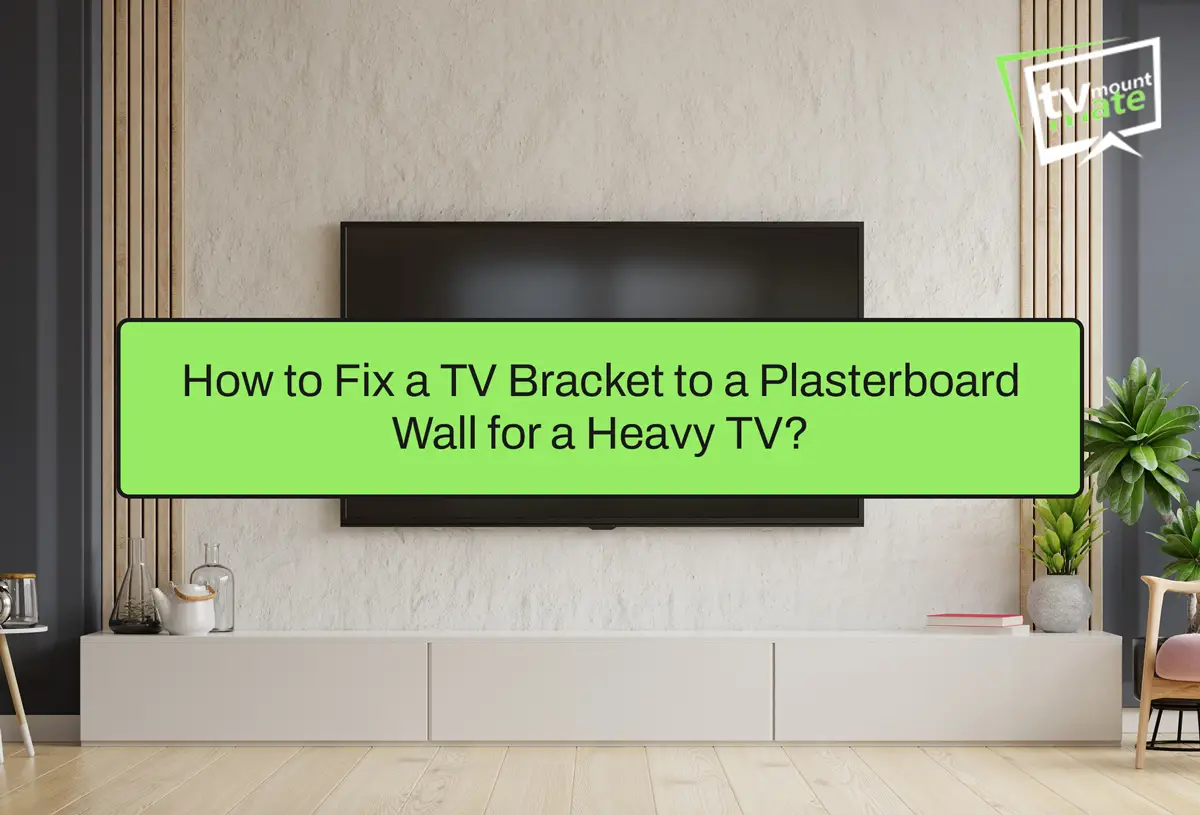
To fix a TV bracket to a plasterboard wall for a heavy TV, first establish how the wall is built and where usable framework sits. Then confirm the television and bracket compatibility, consider the bracket’s leverage and wall-plate positions, and choose a fixing arrangement for that specific wall. If those factors cannot be confirmed, the bracket, position or wall preparation must change. There is no universal fixing method or maximum weight for every plasterboard wall.

For general plasterboard suitability, see our guide on whether a TV can be mounted on plasterboard. This page covers what changes once the television is large or heavy.
Why Does a Heavy TV Change the Fixing Plan?
A heavy television changes the fixing plan because several factors have to be weighed together: verified TV weight, screen size and handling, bracket weight and VESA compatibility, wall-plate design and leverage, wall construction and condition, framework and usable fixing positions, required screen position, socket and cable clearance, and lift requirements such as extra people or equipment.
Screen size alone cannot confirm suitability, and there is no single weight figure above which every plasterboard wall becomes unsuitable.
Installer’s view: This was the heaviest television I had mounted, but it was not the most difficult. Wall construction, bracket choice, alignment, the required position and handling can make a lighter television more technically demanding than a heavier one.
The Professional Process Before Fixing the Bracket
1. Confirm the television and bracket
Confirm the television’s complete model, manufacturer-stated weight and VESA pattern where possible, then check the bracket’s compatibility against the relevant manufacturer instructions. If essential compatibility information cannot be confirmed, do not replace it with an estimate based on screen size. Obtain reliable specifications or treat compatibility as unconfirmed until the missing information is established. The wall fixing method must not be selected from screen size alone.
2. Establish what is behind the plasterboard
“Plasterboard wall” can mean plasterboard over timber studs, over metal framework, a hollow area with no conveniently aligned framework, double-layer board, dot-and-dab over masonry, or plasterboard finished with something like MDF. The construction and condition behind the surface must be established before any fixing arrangement is chosen.
3. Locate usable framework and check for services
Stud positions affect where the wall plate can sit, and framework does not always line up with the required TV position. Pipes and cables must be considered before drilling, and a nearby socket can affect the wall-plate position even where it will not affect the final screen position.
4. Assess the wall plate and bracket leverage
A bracket’s listed capacity is only one part of compatibility. Wall-plate width and hole positions affect which fixing locations are usable, and an extended full-motion bracket creates more leverage than a fixed one, though that does not rule full-motion out automatically. A bracket the customer already owns should not be accepted for a heavy installation simply because it is already on site.
See our guide to choosing a TV bracket for a plasterboard wall for more on bracket types and wall-plate design.
5. Choose a wall-specific fixing arrangement
There is no single fixing product or number of fixings that is correct for every plasterboard wall and heavy television. The right arrangement depends on the wall construction, board condition, framework, the bracket’s wall plate, the TV and bracket combination, leverage, available fixing positions and manufacturer instructions, weighed together for that specific wall.
6. Check the wall plate, lift and complete final checks
The fitted wall plate should be checked before the television is lifted into place. Larger televisions may need extra people or appropriate lifting equipment, and manufacturer handling instructions should be followed. After hanging, check bracket engagement, level, wall movement, clearances, socket access and pressure on the power cable.
Why a Bracket’s Weight Rating Does Not Answer the Whole Question
A bracket’s stated weight capacity addresses one part of the compatibility check, but it does not independently confirm that the complete bracket, wall and television combination is suitable.
This is not a criticism of bracket manufacturers, and it does not mean stated compatibility can be ignored. It simply answers one question, not all of them.
Real Example: A 100-Inch Hisense E7 Pro Mounted in Barking
On 3 August 2026, TV Mount Mate mounted a 100-inch Hisense E7 Pro Series QLED television in a customer’s converted shipping-container office in Barking, IG11. The complete UK model suffix, model year and manufacturer-verified weight could not be reconfirmed during this article update, so they are not published. Before installation, TV Mount Mate checked the final bracket’s stated screen-size, VESA and weight compatibility.
The wall was finished in dark MDF over new, undamaged double-layer plasterboard. Timber studs were identified with a stud finder, and the wall plate spanned more than one identified stud position. No support board or additional reinforcement was installed. The customer was understandably concerned about mounting such a large television.
Changing the bracket. The customer’s One For All bracket had been described as flat before booking, but on-site assessment confirmed it was full-motion. TV Mount Mate did not use it, because of the leverage a 100-inch screen would create on the arm and the available stud positions, not the nearby socket. Had the customer insisted on using that full-motion bracket, TV Mount Mate would have declined that proposed arrangement. The installation could proceed only after a suitable alternative bracket was agreed. This does not mean every full-motion bracket is unsuitable everywhere; this combination did not work.
Choosing the final fixed bracket. TV Mount Mate supplied a fixed VonHaus bracket instead, checked for screen-size, VESA and weight compatibility.

A first fixed-bracket option would have covered the socket at the required height, so this was changed for a VonHaus open-centre fixed bracket, leaving the socket unobstructed without moving it. No electrical work was done; only the existing power lead was connected. The customer wanted the screen centred above the fitted cabinet, with its bottom edge 80cm from the floor and a 10cm gap between the television and the cabinet. Pencil marks were hard to see against the dark MDF, so masking tape marked the lines, and the bracket arms were adjusted to reach the exact height.
The lift. TV Mount Mate and one onsite worker carried out a two-person manual lift, with the worker assisting only with lifting; no lifting equipment was used. The wall plate was checked by hand beforehand, and afterwards TV Mount Mate checked level, bracket engagement, wall movement, clearances, socket access and cable pressure. Nothing unexpected came up beyond the bracket and socket issues already described, and the final position matched the customer’s request.
Full project details are recorded on the 100-inch Hisense E7 Pro installation in Barking page.
What This 100-Inch Installation Demonstrates
A 100-inch television can sometimes be mounted where the visible surface is plasterboard, but this does not prove every plasterboard wall suits a screen that size. The Barking wall had an MDF finish over double-layer plasterboard, with timber framework behind it. The decision did not rely on the visible MDF finish alone. The wall plate, stud positions, bracket and screen position were all considered together. The original full-motion bracket was rejected, and the first fixed-bracket option was also changed because its wall plate would have covered the socket. Weight alone did not make this the hardest job TV Mount Mate has done; the decisions around the wall, bracket and position made the difference.
When Should the Bracket, Position or Wall Plan Change?
The proposed arrangement may need to change if the board is damaged, damp, cracked or weak, if previous holes reduce the usable fixing area, if the wall construction cannot be established with confidence, if no suitable fixing arrangement exists, if framework and wall-plate positions do not match the required location, if bracket compatibility cannot be confirmed, if the leverage is wrong for the wall, if a socket, pipe or cable creates an unresolved problem, if the television cannot be lifted safely, or if a customer insists on an arrangement TV Mount Mate considers unsuitable.
Possible outcomes include a different bracket, a revised height or position, wall reinforcement, further investigation, another mounting surface, or declining the installation. Not every problem can be resolved on the wall as it stands.
Questions About Heavy TVs and Plasterboard Walls
There is no single maximum television weight that applies to every plasterboard wall. Suitability depends on the wall layers and condition, framework, bracket, leverage, fixing positions and manufacturer instructions.
The Barking project shows that it can be possible in a suitable construction. This wall had an MDF finish over double-layer plasterboard, with timber framework identified behind it. The bracket, wall-plate position and complete wall construction were assessed together. This does not prove that every plasterboard wall can support every 100-inch television.
Thickness and layer count are only part of the assessment. Framework, board condition, the bracket, its leverage and the available fixing positions still matter.
Usable timber framework can be particularly valuable for a demanding installation, but there is no rule that applies to every plasterboard wall. In the Barking project, the wall plate spanned more than one identified timber-stud position. That project-specific finding does not determine the correct arrangement for another wall.
Get a Fixed Quote
To get a fixed quote, send your postcode, the TV’s make, model and size, a photo of the proposed wall, your bracket details or photos, the screen position you want, and any cable requirements. You’ll get a fixed quote before booking, with no deposit and payment on completion.
See our plasterboard TV mounting service for more on how this works.
About the Author
Written by: TV Mount Mate
TV Mount Mate has more than 10 years of hands-on TV mounting experience across more than 6,000 completed installations, including several 100-inch televisions in recent years.