

Yes, a TV can be mounted on many stud walls when the wall, television, bracket, fixing positions and required screen position are assessed together. The framework behind the plasterboard may be timber or metal, and suitable studs are preferred where they align with the bracket. When they do not, suitable cavity fixings may sometimes form part of the assessed arrangement, or the bracket or position may need to change. There is no single maximum TV weight that applies to every stud wall.
What Is a Stud Wall?
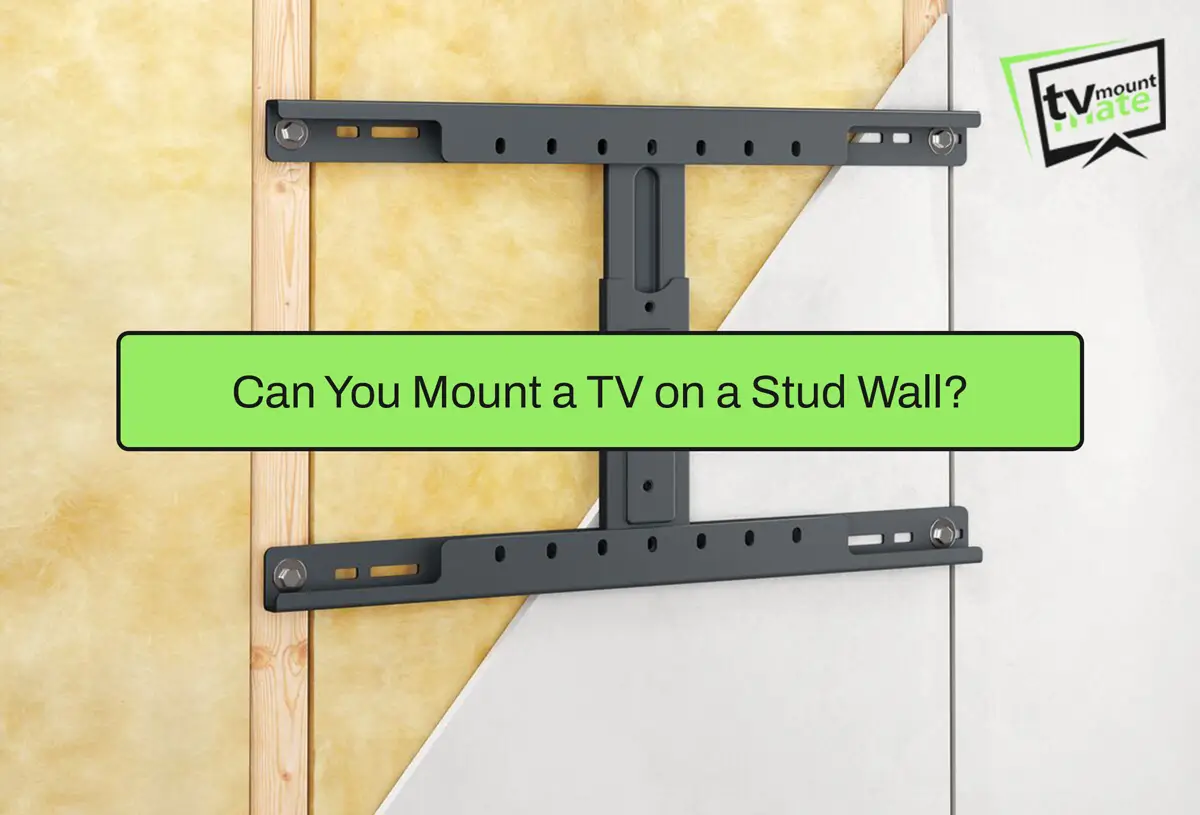
A stud wall consists of vertical timber or metal framework with plasterboard fixed over it. On a stud wall, the plasterboard is the visible surface and the framework sits behind it. This is why “stud wall versus plasterboard wall” is a misleading comparison: a stud wall is commonly finished with plasterboard.
Timber and metal studs require different drilling and fixing approaches. The correct method depends on the framework construction, plasterboard layers, wall-plate design and available fixing positions, so the same screws or method should not be assumed for both. In TV Mount Mate’s experience, metal studs are encountered more frequently in newer developments and timber framework is often found in older or renovated properties. That is an observation from installations, not a rule, so every wall is checked.
A wall that looks like plain plasterboard could have timber studs, metal studs, battens, plywood backing, a hollow cavity, double-layer board, or dot-and-dab plasterboard on masonry, which normally has no stud framework at all. None of this is visible from the surface, which is why it gets checked before anything is drilled.
Our TV mounting on plasterboard walls page covers the general plasterboard question; this page covers walls with a stud framework.
What Has to Be Checked Before Mounting the TV?
Locating a possible stud is only one part of the decision. The board is checked for cracks, damp, loose sections or previous repairs, and for single or double layer, since that affects drilling and fixing choice. Next comes the framework: timber or metal, where the usable studs sit, and whether that lines up with the bracket’s wall plate. A stud finder gives evidence, not automatic confirmation, and readings are read across the whole bracket area rather than trusted from one pass, since wiring, pipes, other metalwork, double-layer board, MDF and insulation can all affect what it reports.
The television matters too: its manufacturer-stated weight and bracket compatibility where confirmable, the height and centring wanted, and whether the bracket is fixed, tilting or full-motion, since each puts a different load through the fixing points. Likely cable and pipe routes are considered before any drilling starts.
What Weight Can a Stud Wall Hold?
There is no single maximum television weight that applies to every stud wall. The framework is hidden until checked, and its material, condition and position all vary. Stud spacing is not standard everywhere, and a wall plate may or may not reach a useful combination of fixing points. Leverage also changes how much load reaches the wall once a bracket is extended, and fixing ratings are tied to specific tested conditions, so a figure on a fixing’s packet does not automatically apply to a wall it was never tested against. These factors are assessed together rather than reduced to a single weight limit.
Our guide to fixing a heavy TV to a plasterboard wall covers how size, weight and bracket leverage interact on a demanding installation.
Can a 55-Inch or 65-Inch TV Be Mounted on a Stud Wall?
TV Mount Mate has mounted many 55-inch and 65-inch televisions on stud walls, and neither size is automatically too large for one. What “55-inch” or “65-inch” does not reveal is the television’s actual weight, whether the studs are timber or metal, where that framework sits, how the wall plate is designed, or whether the required position lines up with usable framework. Two televisions of the same screen size can need different fixing arrangements. The general question of TVs on plasterboard of any size is covered on our dedicated plasterboard page; this section is specifically about stud walls.
Can a 65-Inch TV Be Mounted Using One Stud?
One usable stud can sometimes form part of the fixing arrangement, but it is not automatically enough on its own. That depends on the wall plate, how the fixing points are spread, whether the bracket moves, and the condition of the wall and framework around it.
There is a real difference between a bracket using one suitable stud alongside other appropriate fixing points, and one effectively relying on a single fixing point with nothing else supporting it. TV Mount Mate has completed installations where one position aligned with a stud and the rest used suitable cavity fixings, forming one arrangement rather than a single point taking the whole load. There is no fixed minimum number of studs for every wall, and not every 65-inch television works on one stud regardless of the rest of the setup.
Can a TV Be Mounted When No Usable Stud Aligns?
No usable stud at the required position does not automatically rule out mounting there. Depending on the assessment, options can include a suitable cavity fixing arrangement, a bracket with a wall plate that reaches a more useful combination of points, a revised position, existing plywood backing, fixing through dot-and-dab plasterboard into suitable masonry, or recommending separate wall preparation first. TV Mount Mate does not install wall reinforcement as part of this service, so where that is the answer, it is arranged separately.
Cavity depth, board layers and condition, the bracket’s design and the load proposed are assessed together before any option is chosen. No single fixing is treated as universally suitable, and this is a site decision, not a set of dimensions that could apply to any wall.
Why Full-Motion Brackets Need More Consideration
Extending a full-motion bracket away from the wall increases leverage at the wall plate and every fixing point behind it, so a television that sits comfortably on a fixed bracket can strain the wall considerably more once it is on an arm. Arm length and wall-plate design both affect how much leverage the fixing points need to handle.
A full-motion bracket is not automatically unsuitable, including for large televisions, but the combination has to be assessed rather than assumed. A large screen on a cheap single-arm bracket is a combination TV Mount Mate has rejected on stud walls where it did not suit the leverage involved; a fixed or tilting bracket is sometimes recommended instead simply because it suits that television, wall and position better.
Our guide to best TV brackets for plasterboard walls covers bracket types.
A 77-Inch LG G5 Mounted on a Timber-Stud Wall in Bexley
In 2026, TV Mount Mate mounted a 77-inch LG G5 OLED on a stud wall in Bexley, DA5. The wall was single-layer plasterboard over timber framework, sound and undamaged, with no previous fixing holes, cracks, damp or repairs where the bracket needed to go.

The framework was located with a Bosch stud finder. Exact spacing was not measured, and cavity depth was estimated at around 3cm rather than measured precisely, with no plywood backing behind the board. The customer wanted the screen centred with the TV unit below it, and that position lined up with a usable central timber stud.
Choosing the bracket. The television came with its original LG flush bracket. Its wall-plate layout worked with the required centred position and the identified central timber stud, so a third-party replacement was not needed.

The six-point fixing arrangement used the identified central timber stud together with metal cavity fixings. A coach-screw fixing entered the timber stud. The exact cavity-fixing type was not recorded, so it is not specified here. No reinforcement was added. A Sonos Arc was fitted below the television on its own bracket, and its cable was concealed alongside the television’s power lead, routed through the existing cavity to an existing socket behind the unit. No socket was installed, moved or altered.
The lift. TV Mount Mate carried out a two-person manual lift with the customer assisting, without lifting equipment, after applying downward pressure to the installed wall plate by hand and checking for unwanted movement. Afterwards, bracket engagement, level, locking, wall movement, clearances and cable pressure were all checked. The television sat flush to the wall, the final position matched what the customer asked for, and nothing unexpected came up. TV Mount Mate arranges a two-person lift as standard for any television of 65 inches or larger, since weight alone is not the only consideration; screen dimensions, fragility and handling points matter too, and this is not a guide to lifting a large television alone.
The supplied flush bracket worked here because a usable central stud aligned with its fixing pattern, and the remaining positions formed part of the wider arrangement around it. Not every installation needs a replacement bracket, but the supplied bracket still has to work with the actual wall and position requested.
For information about appointments in this area, see TV wall mounting across Bexley.
When Would TV Mount Mate Change or Refuse the Proposed Installation?
There is a difference between rejecting a wall outright and changing what is proposed for it. In practice, most changes concern the bracket, position or fixing method rather than the whole job.
The plan may change if the board is cracked, damp, crumbling or loose, if the fixing area has been badly repaired or drilled repeatedly, or if the framework is damaged; if the construction cannot be confidently identified; if pipes or cables sit at the intended drilling positions; if there is no suitable fixing arrangement at the position requested; if the wall plate or proposed bracket creates excessive leverage for the fixing points available; if essential information cannot be confirmed; or if a customer insists on a method TV Mount Mate does not consider appropriate. Complete refusal of the whole job is far less common than changing the bracket, method or position to suit the wall.
Questions About Mounting a TV on a Stud Wall
Often, yes, but screen size alone does not confirm it. The television’s actual weight, the framework and the bracket all have to be assessed together first.
Sometimes, as part of a wider arrangement where one stud position works alongside other suitable fixing points. Relying on a single fixing point alone is a different, less suitable arrangement.
There is no universal maximum. It depends on the framework material and condition, stud position, board construction, the wall plate and leverage, and the fixing arrangement assessed for that specific wall.
Often, yes. Depending on the wall, that can mean a suitable cavity fixing arrangement, a different bracket, a revised position, or separate wall preparation before mounting goes ahead.
Get a Fixed Quote
To get a fixed quote, send over your postcode, the TV’s model or size, a clear photo of the wall, any bracket details you already have, the position you want the screen in, and any cable or soundbar requirements. You will get a fixed quote before booking, with no deposit and payment on completion, across Greater London, Essex and Kent.
About the Author
Written by: TV Mount Mate
This guide is based on TV Mount Mate’s own experience: more than 10 years of hands-on TV wall mounting and over 6,000 installations.