
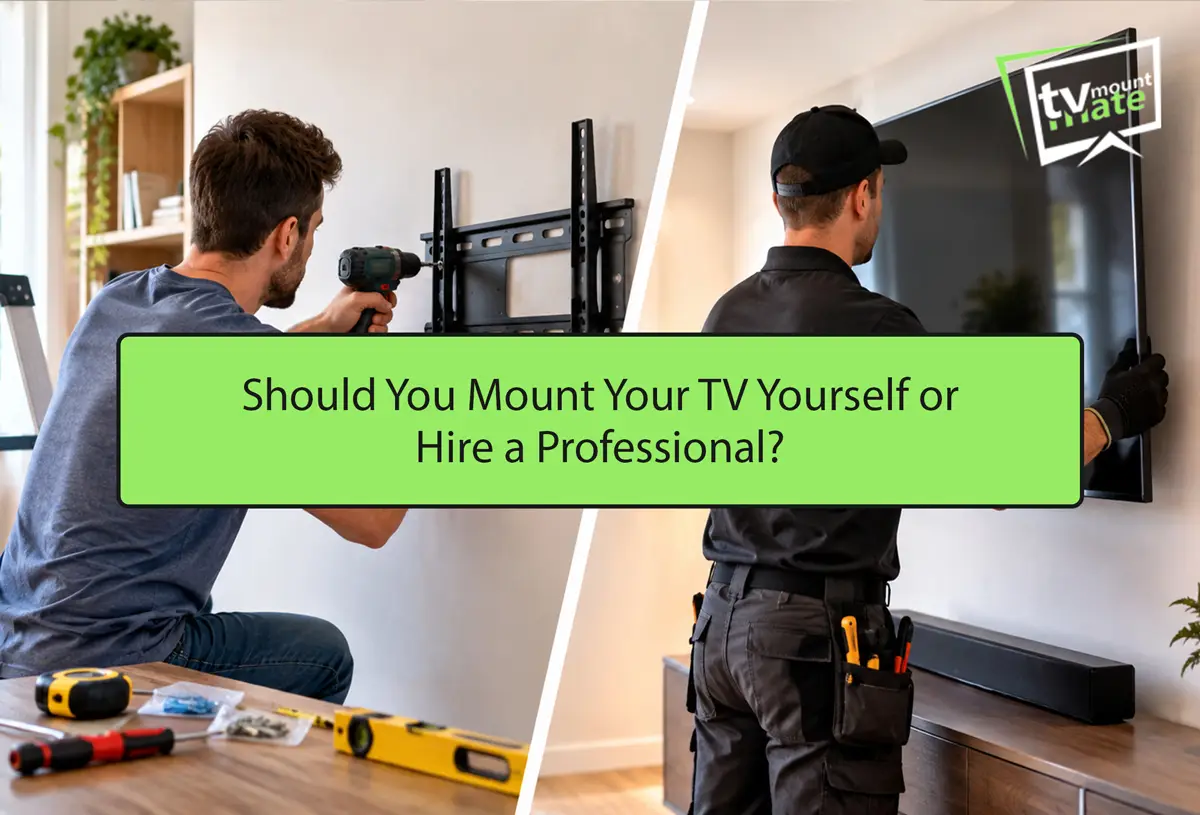
Mounting a TV yourself can be reasonable if you have completed similar DIY work before, know what the wall is made from, have the correct tools and fixings, understand how the bracket works and have enough help to handle the television safely.
Professional advice is worth getting first if you are not confident in your DIY ability, have never drilled into a wall, cannot confidently identify the wall construction, have a kitchen or bathroom on the other side of the drilling area, or suspect cables, pipes or sockets near the proposed fixing points.
I would also recommend getting advice before handling an expensive or fragile television, fitting a complicated bracket, concealing cables or attempting to lift a television you cannot safely control.
A smaller television can be easier to handle, but screen size alone does not make an installation suitable for DIY. The television, wall, bracket, fixing positions, handling requirements and cable plan must be considered together.
This guide is based on more than 10 years of hands-on TV wall mounting and over 6,000 completed installations.
When is mounting a TV yourself realistic?
DIY can be realistic when several things line up at once:
The wall construction and condition are known.
You have relevant drilling and DIY experience.
The bracket is compatible and straightforward.
You have the correct drill, drill bit and fixings.
The television can be lifted safely.
Socket and cable positions have been considered.
You understand how the television engages with the bracket.
A second person is available if the television or manufacturer’s instructions require one.
| Check | DIY may be realistic when | Ask an installer first when |
|---|---|---|
| Wall | The wall construction and condition are confidently known. | The wall type cannot be identified or the fixing area appears damaged. |
| Tools and experience | You have the appropriate drill, drill bits and fixings, and have completed similar DIY work before. | This is your first time drilling into a wall. |
| Bracket | It is a straightforward, compatible bracket that you understand. | It is a full-motion bracket or you are unsure how the TV engages with it. |
| Television handling | The television can be lifted and positioned safely with the required help. | The screen is fragile, difficult to control or you cannot get enough help. |
| Sockets and cables | The cable route, socket clearance and final position have been planned. | A socket, pipe or cable might conflict with the fixing area. |
| Final position | The height and position are settled and work with the bracket. | The height, fixing position or connector clearance remains uncertain. |
This table is a decision aid. It is not a guarantee that an unassessed wall or proposed fixing arrangement is suitable.
The five checks I make before deciding
Before I advise a customer or begin an installation, I assess five connected factors.
1. The wall construction and condition
I need to know whether the wall is brick, concrete, plasterboard, dot-and-dab, timber stud, metal stud or another construction.
I also check whether the proposed fixing area is sound or contains movement, damage, oversized holes or previous unsuccessful fixings.
2. The television
Screen size provides only part of the information. The television’s verified weight, mounting points, shape and handling requirements also matter.
3. The bracket
I check whether the bracket is fixed, tilting or full-motion, whether it is compatible with the television and whether its stated capacity is suitable for the verified television weight.
A bracket should never be selected from screen size alone. The television’s VESA pattern, weight, mounting points and model-specific requirements must fall within the bracket manufacturer’s specifications.
Our guide explaining whether any TV wall mount fits any television covers these compatibility checks in more detail.
4. The fixing positions
The available fixing positions must work with the bracket, wall construction and required television position. The proposed wall plugs, anchors, bolts or screws must also be suitable for that particular arrangement.
5. Sockets, cables and the final position
This is the factor that most frequently turns an apparently simple installation into a more complicated one.
A bracket can be compatible with the television but still conflict with a socket, cable exit, connector or the exact position the customer wants. These details must be considered before drilling.
A wall photograph is useful for initial advice, but it cannot always confirm the construction behind the visible surface.
When should you stop and ask an installer?
Some findings are genuine reasons to stop rather than continue:
The wall construction cannot be confidently identified.
A detector produces unclear readings.
Water pipes or electrical cables might cross the drilling area.
Plasterboard is damaged, weak or moving.
Existing fixing holes are damaged or oversized.
A full-motion bracket would create unsuitable leverage.
The supplied wall plugs or bolts cannot be identified or verified as suitable.
The television cannot be lifted and engaged safely.
In my opinion, the greatest immediate risk is drilling where a water pipe or electrical cable might cross the fixing area. That can turn a wall-mounting mistake into a genuinely dangerous situation.
Some findings require reassessment but are not automatic reasons to abandon the installation.
Timber or metal studs not aligning with the original bracket position might mean repositioning the television or changing the mounting arrangement. Older brick or mortar might require a different drilling and fixing method. A socket behind the proposed screen position might require a different height, bracket, clearance or cable route.
Damaged existing holes are different. They should be assessed before any attempt is made to reuse the fixing area.
Our guide to mounting a television on plasterboard explains how plasterboard construction, framework, wall condition and fixing positions affect the decision.
What I check during an installation
A safe installation still requires checks at several stages. Before drilling, confirm the wall construction, bracket compatibility, required position, available fixing points and likely pipe or cable routes. After mounting, confirm that the wall plate is secure, the television is properly engaged, cables are not trapped and the picture and sound are working.
The complete sequence is covered in our guide explaining how to wall mount a TV safely.
The DIY mistake most guides overlook
One type of call I receive starts with the customer saying their wall is “too strong” or that their new drill will not penetrate it.
When I arrive, I often find that a wood or metal drill bit has been used on brick or concrete. Sometimes the drill is unsuitable for the wall. In one East Ham installation, the customer had not bought a drill bit at all.
Owning a drill is not the same as having the correct drill, bit, setting and fixing arrangement for a particular wall.
A new hammer drill but no drill bit in East Ham
On 23 August 2026, I was called to a property in East Ham, E6, to help mount a 55-inch Sony television.
The proposed position was on a brick chimney breast above an unused electric fireplace.
The customer had bought a new Bosch hammer drill but had not bought any drill bits because they did not realise that a separate bit was required. They had attempted to drive a screw directly into the brick using the drill as a driver.
When that did not work, they called TV Mount Mate.
The television was still inside its box and had not been damaged. The vertical bracket arms had not yet been attached.
The customer had a Sandstrøm STL14 tilting bracket, a pencil and the plugs, screws and bolts supplied with the bracket. They had originally intended to position the wall plate close to the ceiling.
Before drilling, I discussed the final height and clearance above the unused fireplace with the customer. The final position was agreed before the installation continued.
I assessed the brick wall and restarted the job from the beginning, keeping the customer’s Sandstrøm bracket.
I used a Milwaukee hammer drill with a Bosch Blue multi-construction drill bit. The Sandstrøm STL14 tilting bracket was secured using four 8 mm wall plugs and four M6 × 50 mm Turbo Coach screws.
I cannot now confirm the wall-plug brand, so I have not named one.
These fixings were selected for that wall, television, bracket and fixing position after the installation had been assessed. They are not a universal fixing recipe for every brick wall or television.

The customer’s attempted screw mark remained because the completed television concealed it.
The property already had a cable route created by previous occupants. The television’s existing power lead and HDMI cable were routed through that route. No socket was added or moved.

The finished television was secure, level and working.
The DIY mistakes I am most often asked to correct
Using the wrong drill bit, or no drill bit at all, is far from the only problem I encounter.
Other recurring problems include:
Identifying the wall construction incorrectly
Choosing fixings that do not suit the wall
Drilling fixing holes too large
Automatically using the supplied plugs without verifying their suitability
Installing the wall plate out of level
Mounting the television too high
Positioning a full-motion bracket incorrectly
Discovering that bracket parts are missing or incompatible
Reusing an existing loose installation without checking it
These observations come from the installations I have been asked to correct. They are not presented as a statistical ranking.
Mounting a television too high is particularly common. Our TV mounting height guide explains what should be considered before deciding on the final position.
Our separate guide to common TV wall-mounting mistakes includes additional examples from genuine installations.
What does DIY TV mounting really cost?
There is no useful universal price for DIY because the required tools, fixings and corrective work depend on the installation.
The real cost can include:
Buying a drill without the bits required for the wall
Buying unsuitable wall fixings
Buying an incompatible bracket
Abandoning or repairing incorrectly drilled holes
Paying for corrective work after a failed attempt
Spending additional time researching and restarting
Damaging the television, bracket or wall
Most straightforward installations take me around an hour, although the time varies. Concealed cables, full-motion brackets, difficult walls and corrective work can take longer.
For current professional installation prices, use the TV Mount Mate pricing page rather than relying on a general price quoted in a blog article.
My view after more than 6,000 installations
If you have relevant DIY experience, understand the wall and bracket, own the correct equipment and can handle the television safely, mounting it yourself may be realistic.
If you have never drilled into a wall, are uncertain about hidden pipes or cables, cannot identify the wall construction, or are handling an expensive television, I do not think the risk is worth taking without professional advice.
Asking for advice does not commit you to booking an installation. It may simply help you avoid buying the wrong equipment or beginning a job you cannot safely complete.
Frequently Asked Questions
It depends on the wall, television, bracket and your previous experience.
A known brick wall with a straightforward bracket presents different decisions from hollow plasterboard, concealed cables or a full-motion arm. Screen size alone does not determine whether the installation is suitable for DIY.
Professional advice or installation is usually worth considering if you are uncertain about the wall, want cables concealed, have never drilled into a wall or are handling an expensive television.
It may be less necessary for a straightforward installation that you are genuinely equipped and experienced enough to complete.
Only when the television manufacturer permits one-person handling and the screen can be lifted, aligned and engaged without strain.
If the manufacturer’s instructions require two people, or you cannot see and control both sides of the bracket during engagement, use a second person.
Problems I regularly encounter include unsuitable wall fixings, misidentifying the wall, drilling holes too large, mounting the television too high, positioning full-motion brackets incorrectly and using the wrong drill bit.
I have also attended an installation where the customer had bought a drill but did not know that a separate drill bit was required.
TV wall mounting itself does not normally involve fixed electrical work.
If the job requires adding or moving a socket, altering fixed wiring or completing other electrical work, use a competent electrician and follow the applicable electrical-safety requirements. The government’s Approved Document P explains the requirements for electrical work in dwellings.
Yes. A television can fall if the wall, fixings or bracket are unsuitable, or if the television has not engaged correctly with the mount.
The wall construction, TV weight, mounting points, bracket specifications, fixings and final engagement must all be checked together.
The required equipment depends on the wall and bracket.
It may include a suitable drill, the correct bit for the wall, an appropriate detector, a level and fixings matched to the assessed installation. There is no single tool or fixing list that applies to every wall.
Stop and get advice if you cannot identify the wall, suspect a pipe or electrical cable near the drilling area, have never drilled into a wall, cannot verify the bracket or fixings, or cannot lift and engage the television safely.
The same applies when you are not confident enough to complete every stage without guessing.
Get advice before you start
If you would like advice about whether your proposed installation is realistic for DIY, send:
Your postcode
The TV make, model and size
A photograph of the wall
Your bracket details, if you already have one
A short explanation of what you are unsure about
A wall photograph is useful for initial advice, but it may not reveal the complete construction behind the visible surface.
If you would rather have the installation completed for you, TV Mount Mate provides professional TV wall mounting across Greater London and selected areas of Essex and Kent.
You will receive a fixed quote before booking, with no deposit and payment on completion.
About the Author
Written by: TV Mount Mate
This guide is based on more than 10 years of hands-on TV wall mounting and over 6,000 completed installations.