

Yes, a television can usually be mounted on a suitable new-build wall, but “new build” is not a wall construction. The surface might conceal metal or timber studs, dot-and-dab plasterboard over dense masonry, lightweight blockwork or reinforcement installed by the developer.
The television, bracket, fixing positions, sockets, cables and any property restrictions must be considered together before drilling.
This guidance is based on more than 10 years of hands-on TV mounting and over 6,000 completed installations.
Can a TV Be Mounted on a New-Build Wall?
Many new-build walls can support a television once the actual construction and condition have been assessed.
The age of the property and size of the television cannot answer the question on their own. Two walls in the same apartment can be built differently and require different mounting arrangements.
An internal wall is not automatically a metal-stud partition, and an external wall is not automatically dot-and-dab. Tapping, detector readings and photographs can provide clues, but none proves the complete wall construction by itself.
What Might Be Behind a New-Build Wall?
| Possible Construction | What Needs Confirming | What May Change the Plan |
|---|---|---|
| Metal-stud plasterboard | Stud positions, plasterboard layers and any reinforcement behind the wall. | Bracket width, fixing positions and whether a flat or full-motion bracket is suitable. |
| Timber-stud plasterboard | Timber stud locations and the condition of the supporting frame. | Whether the studs align with the required TV position and bracket layout. |
| Dot-and-dab over dense masonry | Cavity depth and the condition of the masonry behind the plasterboard. | Fixing length, drilling depth and the planned cable route. |
| Dot-and-dab over lightweight blockwork | Cavity depth and the exact lightweight block substrate behind the wall. | Choice of fixing system, drilling method and bracket installation approach. |
| Reinforced mounting area | Position, size and extent of the reinforcement installed by the developer. | Whether the reinforcement aligns with the chosen TV bracket. |
| Unidentified or potentially fire-rated wall | Wall construction, fire-rating requirements and any building restrictions. | Stop drilling until the wall specification or developer information is confirmed. |
Different systems may be used within the same room, so the clearest-looking wall is not automatically the simplest wall to use.
Can You Mount a TV on Thermalite or Aircrete Blocks?
Thermalite is Forterra’s aircrete brand. It should not be used as a general name for every lightweight block found behind plasterboard.
Forterra describes Thermalite as lightweight and easy to cut, chase and drill. However, drilling resistance or appearance alone cannot confirm the block’s manufacturer or exact product.
Aircrete behaves differently from dense brick and concrete. Fischer’s product range distinguishes between aircrete anchors and fixings for other substrates, which demonstrates why a plug described only as suitable for “masonry” should not be selected without checking the manufacturer’s approved materials.
Where plasterboard is dot-and-dabbed over the block, the fixing arrangement must also account for the cavity. The block condition, bracket and available fixing positions still matter.
This does not mean Thermalite is automatically too weak for a television. It means the complete wall and fixing arrangement must be assessed together.
Can a TV Be Mounted on Metal Studs?
Yes, a television can be mounted on a suitable metal-stud wall, but the stud positions must work with the required screen position and bracket layout.
Board condition, cavity depth, insulation, bracket movement and any reinforcement inside the wall also affect the plan. British Gypsum produces a support plate for reinforcement inside metal partitions, specifically listing televisions among the heavy items it can help support.
A television does not always have to be attached directly to a stud. Some cavity-only installations may be suitable when the board, cavity, television, bracket and chosen fixing system have been assessed together. Our plasterboard TV mounting guide explains this in more detail.
How Can You Identify the Wall Construction?
Developer drawings and handover documents are useful starting points. Ask what wall system was specified and whether reinforcement was installed behind the proposed television position.
Sockets, existing openings, changes in sound, detector readings and magnets used to locate board screws can provide additional clues. However, no single clue confirms the complete construction.
Hidden services also matter. Electrical Safety First recommends locating concealed cables before drilling and explains that a quality cable detector can help. A detector cannot guarantee that every cable or pipe has been identified.
Does the Bracket Change the Mounting Plan?
A flat bracket keeps the television closest to the wall. A tilting bracket adds a small viewing adjustment, while a full-motion arm creates more leverage when extended.
A smaller wall plate is not automatically better. It may provide fewer usable fixing positions, particularly when studs or reinforcement do not align with the required screen position.
A bracket can be compatible with the television but unsuitable for the available wall construction. Flush-fitting brackets can also conflict with sockets or connectors behind the screen. Our guide to choosing a bracket for a plasterboard wall covers these trade-offs.
Plan the Sockets and Cables Before Drilling
Check the socket positions, HDMI and Ethernet routes, power requirements and connector clearance before marking the bracket.
Metal studs, insulation and reinforcement can obstruct an internal cable route. A connector that requires additional depth may also prevent a close-fitting television from sitting properly against the wall.
Surface trunking may be more realistic where internal concealment is unsuitable. If the work requires adding or moving a socket or altering fixed wiring, use a competent electrician. See the available TV cable-concealment options before deciding.
What Should You Ask the Developer?
If the property has not been completed, ask:
What is the proposed television wall made from?
Has reinforcement been installed, and where is it?
Is the wall part of a tested fire or acoustic system?
Where will the power socket be positioned?
Is conduit planned for HDMI or Ethernet cables?
Are drawings of the wall construction available?
Having this information before the wall is closed can prevent bracket, socket and cable conflicts later.
Warranty, Lease and Fire-Rated-Wall Checks
NHBC states that Buildmark does not cover alterations or additions, or damage caused by that work. This does not mean mounting a television automatically cancels the entire policy, but Buildmark should not be treated as permission to alter a wall. Check your Buildmark policy, developer guidance and lease before proceeding.
If the property is rented or leasehold, consult the tenancy agreement or lease and obtain any required permission. Our separate guide covers mounting a TV in a rented flat.
Applying intumescent filler does not, by itself, prove that a tested wall system’s performance has been restored. British Gypsum states that penetrations must maintain the system’s fire resistance, acoustic separation and structural integrity.
If the wall may form part of fire compartmentation and its specification is unknown, stop and obtain the building information before drilling.
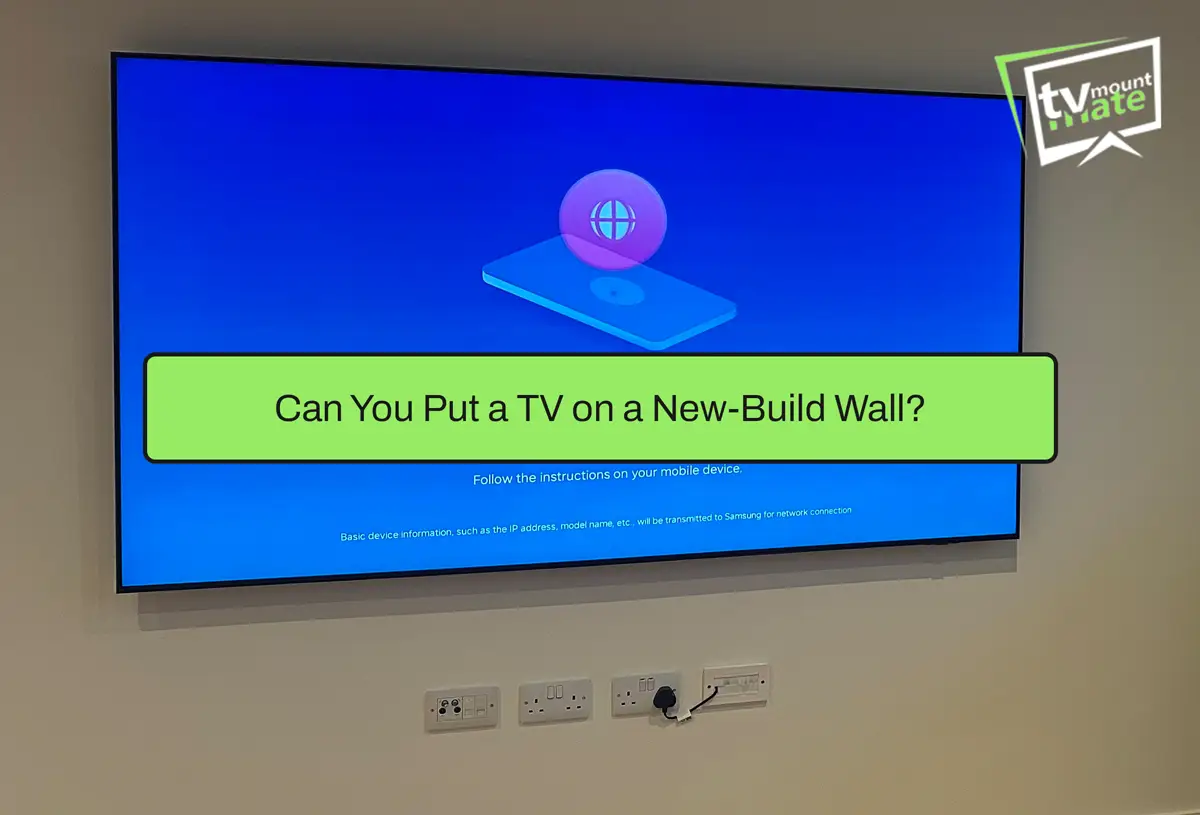
An 83-Inch Samsung Mounted in Canary Wharf, E14
On 28 August 2026, I mounted an 83-inch Samsung television in a penthouse apartment in Canary Wharf, E14. The customer expected a solid wall with plasterboard over it.
The wall opening showed plasterboard, a cavity and soft lightweight blockwork behind it.

The block was soft and easy to drill, but that did not confirm its manufacturer or exact product. I have therefore not described it as confirmed Thermalite or aircrete.
The customer’s original television position remained suitable once the construction was understood. I fitted a flat bracket using six Corefix dot-and-dab fixings, selected for that inspected installation.
The exact Corefix model was not recorded, so it should not be added later without confirmation. Six fixings should also not be treated as a universal recommendation for another television, bracket or wall.
The existing sockets remained below the television, and one HDMI cable was concealed. No power cable was concealed and no socket was added or moved.
The completed television was level, powered on and working in the position agreed with the customer.

The important lesson was that the wall’s appearance and the property’s age did not determine the fixing method. The installation was planned around the construction that was actually found.
When Should You Stop Instead of Drilling?
Stop and seek further advice if:
The wall construction cannot be confidently identified
Detector readings are unclear
Pipes or cables may cross the drilling area
Existing holes are enlarged or damaged
The plasterboard moves or appears weakened
The supporting material crumbles unexpectedly
The fixing is not approved for the substrate found
The wall may be fire-rated but its specification is unknown
A full-motion bracket creates unresolved leverage concerns
The television cannot be lifted and engaged safely
Do not continue by trying different plugs or drilling additional holes until something appears to hold.
Frequently Asked Questions
Usually yes. The wall construction, condition, television, bracket, fixing positions and cable route must be assessed together before drilling.
No. Plasterboard may be the visible surface, but it can cover timber or metal studs, dense masonry, lightweight blockwork or a reinforced mounting area.
A suitable Thermalite or aircrete wall may support a television when the wall build-up, block condition, bracket and fixing system have been assessed together. The chosen fixing must be approved for the substrate found.
Yes, in suitable installations. The stud positions, board condition, reinforcement, bracket layout and required television position must work together.
It may be possible, but screen size alone cannot decide it. The television’s verified weight, board condition, cavity, framework, bracket and fixing positions all matter.
Sometimes. The wall and fixing arrangement must accommodate the additional leverage created when the arm is extended.
Buildmark does not cover alterations or damage caused by them. This does not mean a television installation automatically cancels the entire policy, but you should check the policy and developer guidance before proceeding.
Sometimes. It depends on the wall construction, cable type, route and any studs, insulation, reinforcement or services inside the cavity.
Get Advice About Your New-Build Wall
For initial advice or a fixed quote, send:
Your postcode
TV make, model and size
A wide photograph of the proposed wall
A photograph of any existing opening or socket
Bracket details, if already purchased
Any wall information provided by the developer
Whether the property is rented or leasehold
Photographs can help with the initial assessment but may not reveal the complete wall construction.
TV Mount Mate provides a TV wall mounting service across Greater London and selected areas of Essex and Kent. You will receive a fixed quote before booking, with no deposit and payment on completion.
About the Author
Written by: TV Mount Mate
Based on more than 10 years of hands-on TV wall mounting and over 6,000 completed installations.